By creating a world, with an eye toward it being part of a whole subsector!
Well, first we start with a name. I know, I know ~ it seems like I'm putting the warp nacelles ahead of the cargo bay, but I think figuring out a name first off gives you something you might work off, to establish themes, original colonizing culture, et cetera. And if you don't? Logically speaking, most stars won't be named by colonists anyway.
I like to keep as much randomness as possible, so I went to Wikipedia, hit “Random Article”, and got sent to https://en.wikipedia.org/wiki/Colin_Sheumack. At the moment, we know nothing about the structure of the system, so I'll apply the name to the star itself ~ we're writing about the Bishop Sheumack system. I kinda like including the title in the sun's name; it gives a different feel than other settings.
Thinking about it, I can totally name the mainworld of the Bishop Sheumack system. Rolling the dWikipedia, I get https://en.wikipedia.org/wiki/Roger_Ishee. Ishee will be the name of the mainworld, and we'll place it in a random hex in the subsector. Oooh, but first, let's name that subsector, sector, and quadrant: Eau Pleine subsector (Alpha-3D or Greve-D) in Greve sector (Alpha-3) in Alpha Quadrant. Lets roll for the hex: 0704.
Anyway, Ishee needs some definition. I'm more of a social scifi/anthropological scifi kind of qween, so I like to start with the second half of the bUWP (Basic Universal World Profile). So, rolling 2d6-2, I find that Ishee has more people than the average planet: tens of millions of people live there (Pop digit 7: bUWP α-3D-0704-? (α Greve-Eau Pleine-Bishop Scheumack-Ishee)/????7??-?/?/??/Em).
But how many tens of millions? Using random.org to generate a random 8-digit number, I discover that 16,021,313 live on Ishee. That's about the size of Lagos, Nigeria (city proper) or the Moscow metropolitan area or the entire country of Cambodia!
Next, I roll 3d6 and get a 9, which is greater than the world's Pop digit of 7, so there are no cities of tens of millions on this planet. How about millions? Are there cities of that size? A 10 on 2d6 tells me that no, there are not (again, it's larger than 7). I don't have to roll for cities with hundreds of thousands of people ~ 1d6 will always roll less than 7! Another 1d6 roll gives me a 1, which will result in a very decentralized planet, as that means that there are only (16,021,313/107)*(1+9) cities of this size (the largest). That comes out to 16 of them. Assuming they have an average population of 500,000 for ease, that takes up 8,000,000 of our 16,021,313, leaving us with 8,021,313 people unaccounted for.
Rolling 1d6 again tells us that there are (8,021,313/107)*(4+9)*10 cities with tens of thousands of people. That works out to 104 of them. Of these 3d6-3% ( I rolled a 15, so 12%) will have populations of 90,000 or more. The math says that's 12.513 cities, so I will just barely round up ~ 13 cities of such size exist on Ishee. Overall, however, we again assume these cities average out to about 50,000 people each, accounting for another 5,200,000 of our people. We still need to account for the remaining 2,821,313.
Well, let's run through that formula again, rolling a 2, which gives us (2,821,313/107)*(2+9)*100. That's 310 cities averaging 5000 people each. Rolling 3d6 tlls us that (12-3)% of them have 9000 or more people ~ that's 28 such cities. That's another 1,550,000 people placed in cities, leaving 1,271,313. Let's do another quick run through for the small towns of hundreds of people, rolling a 3 on 1d6. (1,271,313/107)*(3+9)*1000 equals 1526 cities, of which (15-3)%, or 183, have populations of 900 or more. Averaging all those cities out to 500 people each, we realize that they hold a total of 763,000 people. Only 508,313 people remain homeless. Or, rather, they tend to live alone in isolated settlements of no more than maybe a few dozen people (2-4 families), or roam across the surface as traveling folk with no permanent residence.
For future consideration, we designate the ten largest of the cities as primary cities, the remaining 6 cities with hundreds of thousands of people as secondary cities, and all the rest as tertiary.
Now, let's define the planet's major cultural elements. Rolling 1d3, we discover that there are two big Cultural Differences. Rolling 2d66, we get 12 and 61. Let's see . . . looking at the chart . . . the planet is (or hosts) a Tourist Attraction of some sort which attracts Travellers from at least the subsector if not further afield and is Progressive, with an expanding and vibrant culture full of optimism and hope. I'm kind of taken with the idea, at first blush, that this tourist attraction isn't a thing or a place, but a seasonal or annual festival that people come to the planet to see ~ maybe like a futuristic Burning man or a Cherry Blossom Festival or election hoopla . . . .
In addition, there is but a single local custom of note (I rolled a 1 on 1d6). Another 1d6 roll gives me a 5, which tells me that is single local custom of note is something from the “Miscellaneous Customs 1” table . . . That's a 1d66 roll, which gives me a 56, so high tech is allowed for . . . some group of people. Let's head on over to that table, which is another 1d66. But first! I roll a 1d6 and get a 2, s I don't have to roll on the bigger table. A roll of 1-3 tells me that the entire culture practices this custom. Hmmmm, “High tech allowed for everyone”. That sounds to me like a culture that is fiercely protective of access to high technology and deeply distrustful of any attempt to limit it. Think of, say, the NRA's take on the 2nd Amendment, or even more extreme. Maybe mixed in with what are currently more leftist ideals (or non-political and seen as a charity) of removing societal and economic barriers to access.
Maybe that festival I mentioned above, the tourist attraction, is a high tech playground/conference/chance to show off? Depending on how capitalist (ugh!) this world or this subsector turn out, it can be something like a Maker Fair mixed with Burning Man kind of thing or a massive corporate marketing scheme (like, say, E3 or Comic-Con) . . .
Showing posts with label festival. Show all posts
Showing posts with label festival. Show all posts
Tuesday, June 26, 2018

Monday, December 26, 2016
Santa Claus as Post-Scarcity Memeweapon
I'd wanted to get this idea for Eclipse Phase out earlier, but I've a new Dominant and she's been needing ALL the service, so I've been busy!
-----------------------------------


Jovian habitats are enlivened with decorations during the season, however ~ foil, plastic, and even paper are cheap enough to mass-produce after all, even eschewing nanofabrication. Every Jovian civilian is given a small allotment of money by the Republic every Christmas with which to purchase these decorations from vendors vetted and approved by governmental and church censors. Citizens receive a little bit more, enough to fund a few twinkling decorative lights if they take care to budget the cost of the power outlay. The Masses provided by the Church via simulspace (with added XP undertones), however, are even more airy, grand, beautiful, and full of colored light than usual, and most Jovians find themselves drawn to greater attendance during the season, if only to enjoy these magna opera of Church simulspace artisans. Movies, XPs, and simulspace games flood the Jovian mesh with their hybrid of military propaganda, religious themes, and Christmas movie. In years when the Junta and the Planetary Consortium are experiencing political friction, the old movie Santa Claus Conquers the Martians tends to come into popularity (after suitable editing by governmental and Church censors).
Don't think the bleakness of fascist spectacle and VR escapism define the day for Jovians. Many fully enjoy the season, throwing themselves into decorating and family gatherings that sometimes risk edging over the CDC's limit on assemblies. Many Jovians even express gratitude for the restraints placed upon them by their government, claiming that it compels them toward greater intimacy and reminds them to return to more family-focused celebrations. Fond memories of warm celebrations are almost as powerful an escapism as Mass, and creative ways found to get around the nutritional limits. Stories abound in Jovian media and the memories of the people concerning acts of kindness and are brought to life as Jovians pull together to make everyone's lives brighter for the twelve days leading up to the birth of their savior. Caroling is just possible, if the chorus is kept small. Gift-giving even persists as a tradition, with handmade gifts cobbled together with hoarded scraps being the rule. This is as much due to the JCC absorbing elements of American Protestantism vehemently opposed to the commercialization of Christmas as it is due to their resistance to post-scarcity technologies.
It's also where Christophie Odinskind and his team come in.

Born in a Titanian hulder morph well before the Fall to two proud papas, a life consciously modeled after that of old American West cowboys, and an Asatru family tradition, Christophie became a dedicated nanarcho-democrat and member of A-Bloc while attending Titan Autonomous University. Co returned to the peaceful life of a caribouherd after graduation, cor political beliefs disconnected from any action stronger than a presence on the @-list and a voting record in the Plurality. An idle conversation with cor ariel friend Rudolf Morin, a baptized and confirmed member of the Anarchic Roman Catholic Church-in-Exile changed that.
Sitting around taking potshots at ice pebbles, the two began mocking the Jovian Republic, a common enough time-wasting conversation among Titanians and among these two in particular. This time, however, Rudolf began ranting about the JCC, as he often did, and their heretical beliefs around Christmas. Anarchic Roman Catholics have a tendency to describe everything about the JCC as heretical.
Christmas gifts and Santa Claus came up in their conversation, and a spark of inspiration began its quest to fill Christophie's mind with, as they say, An Idea. What better way to undermine Jovian fascism, spread nanarcho-democratic ideals, and have a few yucks than bringing Santa to the beleaguered masses memewashed into scarcity worship?
The two Titanians burned a lot of @-rep and built a decent amount of g-rep only to burn it in order to finance their operation. One EVA sled, a modified olympian morph, a handful of modified ring flyers, and a very visible desktop cornucopia machine later, and they made their first run into Liberty City. It was a modest success, but it was fun and it was enough to attract significant attention from the Jovians, the @-list, the Plurality, and media across the system. That was AF 7; they've continued ever since.
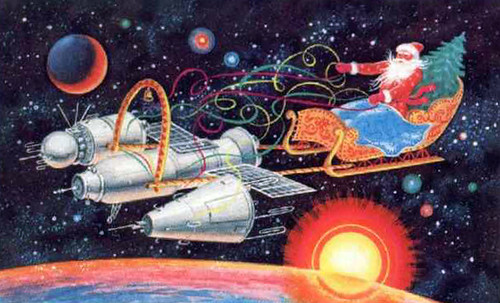
The idea is basic memetic warfare. By leveraging imagery inherent to the Republic's memetic landscape in such a way as to showcase the CM, “Santa” works to inspire the Jovians toward developing a desire, and then a demand, for nanofabrication. Though Christophie believes that this taste for post-scarcity will naturally lead to breakdowns of the fascist regime and an upswelling of nanarcho-democracy, co purchased two griefers after that first run, smuggled them into Liberty City, and began an art/propaganda campaign to ensure that result.
The team has grown, now including 4 transhumans other than Christophie and Rudolf:
* a Titanian journo and hacker covering this daring and artistic effort to undermine the Junta (and hoping to get on MRGCNN in the process) who goes by the name “Goodness's Sake” when embedded as one of Santa's elfs,
* Eetu Laakso, a surya child born after the Fall who won an @-list contest to get a place as an elf last year,
* an AGI from the Jovian moonlet Carpo who loves Christmas as only a virtual Victorian who's lived its life almost entirely in simulspace can and goes by the name Florence Beechworth, and
* Batch Quanta, a scum bot jammer who's one of the Lost, who both serve “Santa” as reindeer
-----------------------------------
* In 1 AF, the Council of Liberty was held on Ganymede. There, the Jovian Catholic Church was founded and almost immediately experienced their first schism. Shortly after the appointment of the Exilic Pope, a large number of delegates stormed out, railing about the Line of Peter, apostolic succession, and the mass murder of the College of Cardinals by the TITANs. These priests quickly began to build what they called the Anarchic Roman Catholic Church-in-Exile, founded upon the theological claim that God had ushered in a new period of the Church in which it had to find His grace without the protection and guiding hand of Peter. Ironically, the ARCCiE both enabled the hardline bioconservatist elements within the JCC to embed their beliefs in doctrine and theology and also represents the closest theology (if not liturgy) to that of pre-Fall Catholicism, as the JCC has incorporated a few elements of American Protestantism (including Mormonism), Russian Orthodoxy, and Chinese Patriotic Catholicism into what does still remain a Roman Catholic framework.
The third largest post-Fall Catholic denomination is a small but rapidly growing group within the ARCCiE. They call themselves the Anarchist Catholic Church of the Enduring and New Third Scripture (ACCENTS). Building a new theology out of combining anarchist political theory with Catholicism, they have begun to compile a new Scripture or Testament from the texts of Christian anarchist and communist writers. Thus, it includes the Books of Francis, the Book of Petr Chelčický, the Books of the Diggers, the Hopedale Book, the Books of William Greene, the Book of the Kingdom of God, the Book of David Lipscomb, the Book of the Heavenly Discourse, the Book of Thomas Hagerty, the Books of Nikolai Berdyaev, the Revelation of Precarity, the Book of Ammon, the Books of Dorothy Day, the Book of Peter Maurin, the Books of Ernst Bloch, the Book of Jacques Ellul, the Books of the Berrigan Brothers, the Book of Ivan Illich, the Book of Diane Drufenbrock, the Book of Camilo Restrepo, the Book of Vernard Eller, and the Books of Alexandre Christoyannopoulos.
Sunday, May 1, 2016
The Halfling Holiday of Longdays
"Sweet you came, and sweet you shall return."
--The Journal of Sacrifices 3:19c (from the Diaries)
When the halfling liturgical calendar embarks into Longdays, a period of forty-eight days of fasting, prayer, repentance, and reflection, often including a rather literal step into the desert, clergy in both the Apostolic Ǽtscúrárite /ǽtʃúrɑ́r/ Church (an inclusive, sacramental, esoteric, and mystical religion with apostolic succession) and the Outer Halfling Church join with religious people from around Walhiska /ɥɑ́rískɑ́/ of various different heritages and backgrounds. Halflings commonly remind themselves and each other that it’s often all too easy to let one’s mind wander while reading the more esoteric texts when, at this time, we should be focusing on making straight the way for the Divine to enter into our hearts.
Probably the most defining feature of Bróƿèo-Tḕrkṑ-Scúcrá /bróɥèotɛ̀rkɔ̀ʃúkrɑ́/ is the imposition of sugar which is made from the sugar canes blessed with the sweat, blood, and pained cries of halfling worshippers on the previous Fréo-Brī̀m-Scǽní /fréobrɪ̀mʃǽŋí/. This sugar is placed on the foreheads of the congregation with the accompanying phrase, “Remember that you are sweet, and still sweet you shall return.” To be sure, it’s a rather strange custom to many outsiders but to the faithful, it is a reminder that mortals were created to be amusement and candy for the gods, that people are therefore fundamentally carefree and joyful, and of their mortality – something that is easily forgotten in the crush and turmoil of daily lives.
"There is nothing noble in being superior to your fellow in ethics or wealth or rank; true nobility is being superior to your former self in pleasantry and beauty and cheer."
--halfling writer Éornòst Fíenƿḕg /éorŋòstfíyŋɥɛ̀g/
The quote by Fíenƿḕg, in many ways, could be said to be a proper quote to an understanding of this season of vows and the value of the role of remembrance in the spiritual process of dissolution, boiling, and caramelization. Mortals must descend and experience the bewildering confusion of being fully dissolved in the milk and water of nature, while at the same time recognizing the need for their own inner caramelization in the process.
When mortals remember, as Ǽngìmúngæ̀m /ǽŋːìmúŋːæ̀m/ speaks that the ‘delight of the gods is a thing we share along with equality’, they can come to a gentle understanding of how they all as a trifle sharing in a common cook all are engaged in this process, which is ultimately redemptive, and thus arrive at gnosis. We share in one another's suffering and learn compassion for the gods, that we are all suffering with, sharing in that sympathy with the Divine Light.
In Nìsèoƿṑsóró's /ŋìsèoɥɔ̀sóró/ writings, the Three Ends of Things are often compared to the three aspects that are present during the process of combustion (i.e. fire, smoke, ash): ‘Whatever burns is sulphur, whatever is humid is mercury, and that which is the balsam of these two is salt’. Nìsèoƿṑsóróans also employ the Three Ends of Things to represent the composition of the mortal microcosm: spirit (mercury), soul (sulphur) and body (salt), and this correlation is extended to some extent to a typology of the gods: the old gods (sulphur), the timeless gods (mercury), and the young gods (salt)."In this manner", states Nìsèoƿṑsóró, ‘in three things, all meets its end […] namely, in salt, in sulphur, and in liquid. In these three things all things are contained, whether sensate or insensate […] So too you understand that in the same manner that mortals are fed into the mouth of the gods, so too all creatures die in the number three’.”
“You are the salt of the earth; but if the salt has become tasteless, how can it be made salty again? It is no longer good for anything, except to be thrown out and trampled under foot by men.”
--Átscék's /ɑ́tʃék/ Diary
Within each mortal there is rot and decay, and unyummy things. It can be a voice from the past which reminds one of how worthless one is when one knows one is not. It can come from obsessing over failures one has made however big or small. It can come from study or work. It can also come from one's spiritual family as well. Longdays is such a time, then, to drop the burden of what one's been carrying for the past weeks or even years and is an invitation for mortal's to start out on a new adventure of forgiving themselves and others for the barriers that they have placed in their hearts which prevent the gods from coming to them more clearly, as well as to improve their flavor in the gods' mouths.
"What makes mortals free is the knowledge, of what they are, of what they can become, of where they were, of wherein they have been cast, of how they are being cooked, of what spices shall compliment their flavor, of what birth truly is, and what rebirth Truly is."
--halfling theologian Nwǽmùmgèmàn /ŋːʷǽmùmgèmɑ̀ŋ/
Subscribe to:
Posts (Atom)