We might be about to get an answer as to how wed to capitalism Ishee is. It's time to roll for the planet's government! Let's see, that's a 2d6-7+Pop roll, and Pop is 7, so it's just a flat 2d6 roll. A 7 tells us that the world is balkanized, or split up into multiple nations (just like ours! Gov digit 7: bUWP α-3D-0704-? (α Greve-Eau Pleine-Bishop Scheumack-Ishee)/????77?-?/?/??/Em). We'll figure out just how many nations in a moment, but first we'll have to look at non-governmental agents. We roll 1d3+1 for how many of those there are, which turns out to be 3.
We roll on the Government table for each of the non-governmental agents in order to see, generally, how they're structured. We get 10, 5, and 6, so we're looking at a charismatic dictator (like a religious messiah or revolutionary leader), a feudal technocracy, and a captive government. In my Traveller setting, “feudal technocracy” (which is kind of a weird term, especially cuz technocracy is a misunderstood and misapplied term in so many cases) refers to a recreation of feudal hierarchy, land ownership rules, and entitled rights by means of hypercapitalist subcontracting. That is, a duke will award a comital contract for the administration of a group of systems within their subsector to someone (granting them all the rights of a count while burdening them with the responsibilities of actual governance), who might then subcontract with someone to monitor the banking industry in their county and awarding them in exchange the title and rights of a viscount or marquis. When the system is working properly, the contract goes to whomever it can be shown will most skillfully be able to fulfill the role (which is the technocratic bit).
ANYWAY: The 7, 8, and 8 I roll on three 2d6 rolls reveal that the charismatic dictator is only a minor power with some supporters, but the other two are notable powers who are well known and enjoy significant support. I'm thinking that the feudal technocracy faction might merely represent the contract noble whose fief is/includes this planet. They want to unify the world for some reason, to forge it into a world-state. Is it for power? It might be, but I'm kind of more enamored by the idea that the noble actually thinks it will be best for the population somehow to bring the various nations of the world together. And with the stateless captive government faction (something of a conundrum), I'm kind of thinking either agents of another world trying to manipulate this one into its control or (maybe more interestingly) a grassroots movement trying to convince the world to let another take over.
A roll of a 5 on 1d6 tells us that there are 4 major nations on the planet. Before we divide up the population among them, I'm gonna roll for their governmental structures, just in case I get another 7. This roll is 2d6-7+(Pop-1), or 2d6-1 in this case. Let's see . . . 3, 5, 5, 6. Well! That's an awful lot of feudal technocracies there! This time with a state, as is another captive government. The 3 means that one nation is a self-perpetuating oligarchy.
My current thoughts on the political situation (I'm gonna give the nations and cities random Wikipedia names at this point; I'll add the link, too):
The Guild-State of the Rose Brothers (6,174,679). The Guild of the Rose Brothers is a group dedicated to innovation and invention. Think a cross between the Freemasons, the Rosicrucians, Maker Fair, and Noisebridge. They're a semi-mystical lightly anarchistic fraternal order to which you gain admission by demonstrating that you've improved some already existing piece of technology or methodology. You join its highest levels only by creating something new, introducing some major, paradigm-shifting innovation or invention. Major cities: Haldon (primary: 799,023 people), Scopula Vicina (primary: 650,169 people), Pursuit of Life (primary: 599,580), Balvaneh-ye Motamedi (primary: 532,214), Barnette City (secondary: 445,786), The Bridges (secondary: 173,828)
Oleinik March (4,105,907). The (vis)county which contains the Bishop Sheumack system recently had its contract awarded to a new (vis)count; I think the previous one died of natural causes (age?). That dead former viscount was far more interested in the activities and opportunities in the Duke's court than in actually administering their territory. I think maybe they aren't dead at all, but managed to win a higher contract that had an exclusivity clause. Regardless, they had a great fear that their underlings would overthrow them and take their contracted position. So administration of the Bishop Sheumack system was contracted to two consular marquises, one of Oleinik and one of Jermlaine. While the large print of their contracts set out how they were to administer the system together, the nature of the two marquises and the small print ensured that they would spend all of their energy struggling for an edge over the other and never being secure enough to move against their contract liege. Major Cities: Nueva Veracruz (primary: 796,209), Machrihanish (primary: 555,167), Neo-Edinburgh (primary: 466,559), Thorell (secondary: 373,164)
Jermaine March (4,453,070). See above. Major Cities: Landell de Moura City (primary: 761,773), Daedalus City (primary: 544,487), Amiman (secondary: 239,206), Luisa Maffi City (secondary: 100,368)
TCI (the captive state; 1,287,657) . . . I have no inspiration for this yet, other than that it leads to an offworld polity. Major Cities: Moa (primary: 758,380), Sun City (secondary: 204,087)
Similarly, the nature of the charismatic dictator eludes me as of yet, but stateless feudal technocracy faction will be agents of the new (Vis)Count, who is much more conscientious than the last one and has their agents on the world working for peace and integration among the various nations. It'll just make their job easier. Finally, there's the captive state stateless faction: I'm thinking that they'll be a cold war kind of thing. The captive state that has territory is at war with another polity and that polity has sent agents to this world to strike against that outpost.
Tuesday, July 3, 2018

Sunday, July 1, 2018
Character Creation Outline (Design Domingo #2)
To make things easier on myself, I'm gonna try to rip elements of other systems from their original context and chassis and weld them to each other as much as possible. The core such things, I think, are Pendragon, Unknown Armies, Legend of the Five Rings, and Exalted (though that last, at least, might better be called an inspiration rather than a direct contributor). Oh, and D&D itself, of course, primarily of the 3.x editions (particularly Pathfinder), as I am of the age wherein I was graduating high school when 3.0 came out, causing me to totally imprint on it as the height of D&D design. Now that we’re two whole editions beyond that point, I think I can safely call myself a grognard now? I also have no idea what this GURPS 4th edition nonsense is, and am wary of Savage Worlds “fixing” the gloriously broken and baroque Deadlands system. But back to Middens & Morals . . .
Interestingly, the famous Monty Python scene actually serves as an almost spot-on inspiration for this Heartbreaker game. We know from our meta-knowledge that King Arthur is, in fact, the glorious sub-Messiah of Britain, paragon (and advocate) of chivalry, chock-full of virtue, second only to Galahad and the foolish Percival in these respects. But different meta-knowledges tell us that the man working in the shit is absolutely 100% right. The system of Heavenly virtue King Arthur represents, while striving for and achieving the best of what humanity can be, is based on “outdated imperialist dogma which perpetuates the economic an' social differences in our society!” and on “violence inherent in the system.” Other media inspirations can include A Song of Ice and Fire (though with less rape, thank you), particularly storylines like Sansa’s and the Hounds and Jaime’s, and Paul Verhoeven’s first English-language movie Flesh+Blood from 1985 (when I was three!). There’s only one rape in that last inspiration, but that can easily be too many for many people, so trigger warning. I’ven’t seen Robert Bresson’s 1974 Lancelot du Lac or Aleksei German’s 2013 Hard to Be a God, but they sound like they could help inspire the kind of mood I’m looking for. Bookwise, Chaucer’s Canterbury Tales are perhaps the paradigmatic encapsulation of Middens & Morals’s intended blend of things, perhaps especially when read alongside one of my all-time favorite books (and one of two books that I’ve ever intentionally stolen from a library) Excrement in the Late Middle Ages: Sacred Filth and Chaucer’s Fecopoetics, by Susan Signe Morrison. I also rather enjoy, and will likely be baking into this Heartbreaker project, John Boswell’s Same-Sex Unions in Pre-Modern Europe and Silvia Federici’s Caliban and the Witch. Like Lancelot du Lac and Hard to Be a God, Steve Silberman’s Neurotribes seems like it will also be of use to me once I read it. Finally, I would also like to direct you to what is now a vast literature by pagan/polytheist/occultist anti-capitalists concerning the spell of disenchantment capitalism cast over the world and the resultant activist praxis of re-enchanting it.
I’m having some trouble identifying any sources beyond these, however. Do any of my (possibly imaginary) readers have any ideas?
In order to ensure that I got my ideas out, I copypasta’d the text from a number of my source RPGs and then blended them together and modified them to fit my vision or Middens & Morals. That’s (mostly) what will follow for several posts. Please don’t hate (or sue) me!
When generating a character, start with your character’s concept. Do you want a character who goes toe-to-toe with terrible monsters, matching sword, shield, and sanity against claws and fangs? Or do you want a mystical seer who draws his powers from the great beyond to further his own ends? Nearly anything is possible. Once you have a general concept worked out, use the following steps to bring your idea to life, recording the resulting information and statistics on your Middens and Morals character sheet (we often like to call it a “midden sheet”), which I will create . . . at some point >.<
Step 1—Determine Traits: We start by ditching the traditional six ability scores of D&D. We're not concerned here with where someone's talents lie or what muscles are best developed in their body. Power in this system comes from madness and virtue. Here I hit the first possible Heartbreaker moment (hey, it keeps me honest about what this is): I'm replacing the faux-simplicity of six attributes with a total of 36 >.< Lemme explain. I’m thinking I’ll rip the Virtue system out of Pendragon, giving us 13 pairs of traits (we'll call them Virtues, no matter what we may think of them). That covers the quest for holiness half of Middens & Morals, so I’ll turn to Unknown Armies for the other 10 traits. In that game, the madness meters are a way of describing how traumatized a character is by the events around them, and they come in two varieties: hardened and failed, measuring five types of trauma (5x2=10, obvi). These thirteen opposed pairs of Virtues and five pairs of Traumas determine your character’s most basic personality and are used to decide a wide variety of details and statistics. Some class selections benefit greatly if you have better than average scores for some of your traits.
Step 2—Pick Your Race: Next, pick your character’s race, noting any effects your choice has on rolling with your traits and any other racial qualities. There are seven basic races in Galatia to choose from, although your GM might have others to add to the list.
Step 3—Pick Your Class: A character’s class represents a profession, such as fighter or wizard. If this is a new character, they start at 1st level in his chosen class. As they gain experience points (XP) for defeating monsters, they go up in level, granting them new powers and abilities.
Step 4—Pick Skills and Select Feats: Determine the number of skill ranks possessed by your character, based on their class, each of which utilizes a different trait to determine that number (and any other bonuses, such as the bonus received by humans). Then spend these ranks on skills, but remember that you cannot have more ranks than your level in any one skill (for a starting character, this is usually one). After skills, determine how many feats your character receives, based on their class and level, and select them.
Step 5—Buy Equipment: Each new character begins the game with an amount of money, based on their class, that can be spent on a wide range of equipment and gear, from chainmail armor to leather backpacks. This gear helps your character survive while adventuring. Generally speaking, you cannot use this starting money to buy magic items without the consent of your GM.
Step 6—Finishing Details: Finally, you need to determine all of a character’s details, including their starting hit points (hp), Armor Class (AC), saving throws, initiative number, and attack values. All of these numbers are determined by the decisions made in previous steps. A level 1 character begins with maximum hit points for their Hit Die roll. Aside from these, you need to decide on your character’s name, physical appearance, chivalric domain (the battlefield, the home, or the heart), and religion. The former two don’t have any game-mechanical effects but can certainly affect the narrative of the game! The latter two, however, identify the goals your character strives for in terms of their traits, and what the benefits in game mechanics of achieving those goals are. It is best to jot down a few qualities of their personality beyond those which have a mechanical effect in the game as well, to help you play the character during the game. Determine where your character grew up and their resulting native tongue. A character knows a number of additional languages equal to five less than one-sixth the sum of their Lustful, Energetic, Deceitful, Worldly, Trusting, and Failed Isolation (if the result of the calculation is negative, that character only speaks their cribtongue). Some characters may want to take otherworldly or magical languages; they may only take one such per point of Hardened Unnatural they possess.
Interestingly, the famous Monty Python scene actually serves as an almost spot-on inspiration for this Heartbreaker game. We know from our meta-knowledge that King Arthur is, in fact, the glorious sub-Messiah of Britain, paragon (and advocate) of chivalry, chock-full of virtue, second only to Galahad and the foolish Percival in these respects. But different meta-knowledges tell us that the man working in the shit is absolutely 100% right. The system of Heavenly virtue King Arthur represents, while striving for and achieving the best of what humanity can be, is based on “outdated imperialist dogma which perpetuates the economic an' social differences in our society!” and on “violence inherent in the system.” Other media inspirations can include A Song of Ice and Fire (though with less rape, thank you), particularly storylines like Sansa’s and the Hounds and Jaime’s, and Paul Verhoeven’s first English-language movie Flesh+Blood from 1985 (when I was three!). There’s only one rape in that last inspiration, but that can easily be too many for many people, so trigger warning. I’ven’t seen Robert Bresson’s 1974 Lancelot du Lac or Aleksei German’s 2013 Hard to Be a God, but they sound like they could help inspire the kind of mood I’m looking for. Bookwise, Chaucer’s Canterbury Tales are perhaps the paradigmatic encapsulation of Middens & Morals’s intended blend of things, perhaps especially when read alongside one of my all-time favorite books (and one of two books that I’ve ever intentionally stolen from a library) Excrement in the Late Middle Ages: Sacred Filth and Chaucer’s Fecopoetics, by Susan Signe Morrison. I also rather enjoy, and will likely be baking into this Heartbreaker project, John Boswell’s Same-Sex Unions in Pre-Modern Europe and Silvia Federici’s Caliban and the Witch. Like Lancelot du Lac and Hard to Be a God, Steve Silberman’s Neurotribes seems like it will also be of use to me once I read it. Finally, I would also like to direct you to what is now a vast literature by pagan/polytheist/occultist anti-capitalists concerning the spell of disenchantment capitalism cast over the world and the resultant activist praxis of re-enchanting it.
I’m having some trouble identifying any sources beyond these, however. Do any of my (possibly imaginary) readers have any ideas?
In order to ensure that I got my ideas out, I copypasta’d the text from a number of my source RPGs and then blended them together and modified them to fit my vision or Middens & Morals. That’s (mostly) what will follow for several posts. Please don’t hate (or sue) me!
When generating a character, start with your character’s concept. Do you want a character who goes toe-to-toe with terrible monsters, matching sword, shield, and sanity against claws and fangs? Or do you want a mystical seer who draws his powers from the great beyond to further his own ends? Nearly anything is possible. Once you have a general concept worked out, use the following steps to bring your idea to life, recording the resulting information and statistics on your Middens and Morals character sheet (we often like to call it a “midden sheet”), which I will create . . . at some point >.<
Step 1—Determine Traits: We start by ditching the traditional six ability scores of D&D. We're not concerned here with where someone's talents lie or what muscles are best developed in their body. Power in this system comes from madness and virtue. Here I hit the first possible Heartbreaker moment (hey, it keeps me honest about what this is): I'm replacing the faux-simplicity of six attributes with a total of 36 >.< Lemme explain. I’m thinking I’ll rip the Virtue system out of Pendragon, giving us 13 pairs of traits (we'll call them Virtues, no matter what we may think of them). That covers the quest for holiness half of Middens & Morals, so I’ll turn to Unknown Armies for the other 10 traits. In that game, the madness meters are a way of describing how traumatized a character is by the events around them, and they come in two varieties: hardened and failed, measuring five types of trauma (5x2=10, obvi). These thirteen opposed pairs of Virtues and five pairs of Traumas determine your character’s most basic personality and are used to decide a wide variety of details and statistics. Some class selections benefit greatly if you have better than average scores for some of your traits.
Step 2—Pick Your Race: Next, pick your character’s race, noting any effects your choice has on rolling with your traits and any other racial qualities. There are seven basic races in Galatia to choose from, although your GM might have others to add to the list.
Step 3—Pick Your Class: A character’s class represents a profession, such as fighter or wizard. If this is a new character, they start at 1st level in his chosen class. As they gain experience points (XP) for defeating monsters, they go up in level, granting them new powers and abilities.
Step 4—Pick Skills and Select Feats: Determine the number of skill ranks possessed by your character, based on their class, each of which utilizes a different trait to determine that number (and any other bonuses, such as the bonus received by humans). Then spend these ranks on skills, but remember that you cannot have more ranks than your level in any one skill (for a starting character, this is usually one). After skills, determine how many feats your character receives, based on their class and level, and select them.
Step 5—Buy Equipment: Each new character begins the game with an amount of money, based on their class, that can be spent on a wide range of equipment and gear, from chainmail armor to leather backpacks. This gear helps your character survive while adventuring. Generally speaking, you cannot use this starting money to buy magic items without the consent of your GM.
Step 6—Finishing Details: Finally, you need to determine all of a character’s details, including their starting hit points (hp), Armor Class (AC), saving throws, initiative number, and attack values. All of these numbers are determined by the decisions made in previous steps. A level 1 character begins with maximum hit points for their Hit Die roll. Aside from these, you need to decide on your character’s name, physical appearance, chivalric domain (the battlefield, the home, or the heart), and religion. The former two don’t have any game-mechanical effects but can certainly affect the narrative of the game! The latter two, however, identify the goals your character strives for in terms of their traits, and what the benefits in game mechanics of achieving those goals are. It is best to jot down a few qualities of their personality beyond those which have a mechanical effect in the game as well, to help you play the character during the game. Determine where your character grew up and their resulting native tongue. A character knows a number of additional languages equal to five less than one-sixth the sum of their Lustful, Energetic, Deceitful, Worldly, Trusting, and Failed Isolation (if the result of the calculation is negative, that character only speaks their cribtongue). Some characters may want to take otherworldly or magical languages; they may only take one such per point of Hardened Unnatural they possess.
Friday, June 29, 2018
Boanerges of Prester is born (Fantasy Friday #2)
Nurture is the first area the character received training or which they put effort into improving. The adult (cuz it’s strength 5) black dragon here picks up the themes of the Spirit card ~ cunning, sneakiness, and lies. It appears that it was one of those random things which exert so much force on our lives that led this character to their class. They didn’t set out to become a vigilante; chance pushed them down this path. Nurture gives its token to Dexterity.
I think I’ll name the character Boanerges, or something like that; they remind me of those two somehow. They have all the force of a lightning bolt, funneled into a subtle fight for minds and souls in order to save their own infected one.
The Red Dragon 10 in Dexterity steals Strength’s two tokens, furthering the theme of constrained force, I suppose. I think Boanerges was raised to be a soldier, a vain and venereal bravo filled with a dark panache, but a chance encounter in a military raid brought them to the side of the angels. Literally. But one soldier against an army, let alone the nation that sent them, is a losing proposition. So Boanerges turned to shadier methods to spread the word.
Strength, in its turn, steals two tokens from Intelligence as it is also an adult Red Dragon. Panache was glorified and fostered in the army’s ranks, but questions weren’t. Venal tastes were catered to, pointless pleasures and decadent diversons employed to keep the bravos from rebelling. A third adult Red Dragon lurks in Intelligence’s land, stealing two tokens from Wisdom. Armies like this one present a paradox: it does everything it can to restrict the exercise of intelligence, which means that a piercing mind is the only thing that allows promotion.
An old bronze dragon in Wisdom gives its token to Dexterity. Constraining the thunderous force of Boanerges’s personality into clandestine activities breeds skill, but discernment has a tendency to disappear into discomfort. Planning is replaced by quick wits. As Boanerges’s angelic master pushed them away from their chaotic life into one of discipline and honor, their heuristic, social, and behavioral skills prove less and less useful, more and more foolish, even when drawn upon in the appropriate situations. But it also pushes them to become damn good at what they do.
The old Gold Dragon in Charisma passes two of its four tokens to Constitution. Recently, Boanerges had to take a severe beating in order to cover for a fellow bravo they had managed to convert to the way of good after months of work. This act of self-sacrificing nobility left them humbled but even more resilient than before. Significantly more resilient, as the Dracolich in Constitution (the last card in the reading) steals a token from all the evil dragons in the spread: Strength, Dexterity, and Intelligence.
Constitution ends up with a freakin’ 14 tokens! That’s one more than the 13 needed for a 17 Constitution. According to the article, I take that token and apply it to the next highest score. But Dexterity would be in the situation, as it has exactly enough for a high Dex. I should skip the tie between Intelligence and Charisma and apply the token to Strength. However, it makes more sense for this character to give it to Charisma, I think, so I’ma do that. Boanerges’s ability scores come out to
Strength 11 [1 point]
Dexterity 15 [7 points]
Constitution 17 [13 points]
Intelligence 12 [2 points]
Wisdom 9 [-1 point]
Charisma 13 [3 points]
OK, I seem to have chosen a class and even an initial feat for Boanerges, so lemme backtack a bit and consider a class. The region of my campaign world in which celestials are the biggest deal religiously is roughly equivalent (in geographical and geohistorical relation to other regions, at least) to Eastern Africa. Ethiopia and the like. While I always try to do all the research and include actual elements from a variety of real-world and literary sources, I am by no means an Africa scholar, and this region is in no ways intended to actually represent East Africa. As a nod to the ancient, questionable European legends that inspired me to make this region the angelic one, I’ve named it Prester.
My world-creation has been focused on Aoqina (roughly, Europe) and Scarhas (roughly, the Middle East) so far, so I’m not yet certain what the racial makeup of the area is like. Elfs exist all across the surface of the world, and dwarfs can easily pop up anywhere. Halflings are an Aoqinan race, but they’ve been around a helluva long time, so they’ve spread. Gnomes came into existence on the border between Aoqina and Scarhas, as dwarfin sailors bred with merbunnies (descendants of outcast anthropomorphic rabbits from the moon) in the Hemaya Sea, but that was also a long time ago. Now, gnomes range far and wide. Gnomes gave rise to gnolls in Aoqina a decent time ago by breeding with trolls OD&D style, so they’ve had time to spread, but they’re prolly pretty exotic by the time you hit the equivalent of, say, western China or of the Congo Basin (though more headed south from Aoqina than any other direction). Humans are the leavings of a uselessly successful gnollish magickal experiment. They sought to remove all that was obedient from them to ensure their everlasting freedom, but that left only an unintelligent animal: the hyena. The intelligent humans were the obedient bits they discarded, and are pretty young as a race, so are unlikely to be found in significant numbers outside of the three regions bordering the Voda Sea (Aoqina, Scarhas, and my equivalent of the Maghreb/North Africa).
So, Prester’s population of standard races, to summarize:
Dwarfs: Possible, but somewhat unlikely
Elfs: As common as elfs ever get
Gnomes: Uncommon
Halflings: Common, but a minority
Humans: Rare
Orcs: Absent
I also note that a full quarter of the Three-Dragon Ante spread is red dragons ~ this suggests maybe a direction to start looking beyond the standard seven races. Red dragons live in warm mountains, I wonder what comes up on www.pfsrd.com with that ecology . . . . Naw, nothing useful comes from that search. I consider ifrit (I don’t think I want an elemental theme to races in Presterjho), kobold (possible, draconic, but a little small for the sheer force of personality I’m imagining), tiefling (currently the front-runner, but a little on-the-nose), kuru (tied with tiefling, currently), I keep coming back to the goblinoids but their homes are on an entirely different continent. The charau-ka are interesting, with tactics based on intimidation and exuberance which could blend in the swashbuckly elements I’m imagining.
I think I’ll name the character Boanerges, or something like that; they remind me of those two somehow. They have all the force of a lightning bolt, funneled into a subtle fight for minds and souls in order to save their own infected one.
The Red Dragon 10 in Dexterity steals Strength’s two tokens, furthering the theme of constrained force, I suppose. I think Boanerges was raised to be a soldier, a vain and venereal bravo filled with a dark panache, but a chance encounter in a military raid brought them to the side of the angels. Literally. But one soldier against an army, let alone the nation that sent them, is a losing proposition. So Boanerges turned to shadier methods to spread the word.
Strength, in its turn, steals two tokens from Intelligence as it is also an adult Red Dragon. Panache was glorified and fostered in the army’s ranks, but questions weren’t. Venal tastes were catered to, pointless pleasures and decadent diversons employed to keep the bravos from rebelling. A third adult Red Dragon lurks in Intelligence’s land, stealing two tokens from Wisdom. Armies like this one present a paradox: it does everything it can to restrict the exercise of intelligence, which means that a piercing mind is the only thing that allows promotion.
An old bronze dragon in Wisdom gives its token to Dexterity. Constraining the thunderous force of Boanerges’s personality into clandestine activities breeds skill, but discernment has a tendency to disappear into discomfort. Planning is replaced by quick wits. As Boanerges’s angelic master pushed them away from their chaotic life into one of discipline and honor, their heuristic, social, and behavioral skills prove less and less useful, more and more foolish, even when drawn upon in the appropriate situations. But it also pushes them to become damn good at what they do.
The old Gold Dragon in Charisma passes two of its four tokens to Constitution. Recently, Boanerges had to take a severe beating in order to cover for a fellow bravo they had managed to convert to the way of good after months of work. This act of self-sacrificing nobility left them humbled but even more resilient than before. Significantly more resilient, as the Dracolich in Constitution (the last card in the reading) steals a token from all the evil dragons in the spread: Strength, Dexterity, and Intelligence.
Constitution ends up with a freakin’ 14 tokens! That’s one more than the 13 needed for a 17 Constitution. According to the article, I take that token and apply it to the next highest score. But Dexterity would be in the situation, as it has exactly enough for a high Dex. I should skip the tie between Intelligence and Charisma and apply the token to Strength. However, it makes more sense for this character to give it to Charisma, I think, so I’ma do that. Boanerges’s ability scores come out to
Strength 11 [1 point]
Dexterity 15 [7 points]
Constitution 17 [13 points]
Intelligence 12 [2 points]
Wisdom 9 [-1 point]
Charisma 13 [3 points]
OK, I seem to have chosen a class and even an initial feat for Boanerges, so lemme backtack a bit and consider a class. The region of my campaign world in which celestials are the biggest deal religiously is roughly equivalent (in geographical and geohistorical relation to other regions, at least) to Eastern Africa. Ethiopia and the like. While I always try to do all the research and include actual elements from a variety of real-world and literary sources, I am by no means an Africa scholar, and this region is in no ways intended to actually represent East Africa. As a nod to the ancient, questionable European legends that inspired me to make this region the angelic one, I’ve named it Prester.
My world-creation has been focused on Aoqina (roughly, Europe) and Scarhas (roughly, the Middle East) so far, so I’m not yet certain what the racial makeup of the area is like. Elfs exist all across the surface of the world, and dwarfs can easily pop up anywhere. Halflings are an Aoqinan race, but they’ve been around a helluva long time, so they’ve spread. Gnomes came into existence on the border between Aoqina and Scarhas, as dwarfin sailors bred with merbunnies (descendants of outcast anthropomorphic rabbits from the moon) in the Hemaya Sea, but that was also a long time ago. Now, gnomes range far and wide. Gnomes gave rise to gnolls in Aoqina a decent time ago by breeding with trolls OD&D style, so they’ve had time to spread, but they’re prolly pretty exotic by the time you hit the equivalent of, say, western China or of the Congo Basin (though more headed south from Aoqina than any other direction). Humans are the leavings of a uselessly successful gnollish magickal experiment. They sought to remove all that was obedient from them to ensure their everlasting freedom, but that left only an unintelligent animal: the hyena. The intelligent humans were the obedient bits they discarded, and are pretty young as a race, so are unlikely to be found in significant numbers outside of the three regions bordering the Voda Sea (Aoqina, Scarhas, and my equivalent of the Maghreb/North Africa).
So, Prester’s population of standard races, to summarize:
Dwarfs: Possible, but somewhat unlikely
Elfs: As common as elfs ever get
Gnomes: Uncommon
Halflings: Common, but a minority
Humans: Rare
Orcs: Absent
I also note that a full quarter of the Three-Dragon Ante spread is red dragons ~ this suggests maybe a direction to start looking beyond the standard seven races. Red dragons live in warm mountains, I wonder what comes up on www.pfsrd.com with that ecology . . . . Naw, nothing useful comes from that search. I consider ifrit (I don’t think I want an elemental theme to races in Presterjho), kobold (possible, draconic, but a little small for the sheer force of personality I’m imagining), tiefling (currently the front-runner, but a little on-the-nose), kuru (tied with tiefling, currently), I keep coming back to the goblinoids but their homes are on an entirely different continent. The charau-ka are interesting, with tactics based on intimidation and exuberance which could blend in the swashbuckly elements I’m imagining.
Tuesday, June 26, 2018
Well, let's start where everyone starts (Traveller Tuesday #1)
By creating a world, with an eye toward it being part of a whole subsector!
Well, first we start with a name. I know, I know ~ it seems like I'm putting the warp nacelles ahead of the cargo bay, but I think figuring out a name first off gives you something you might work off, to establish themes, original colonizing culture, et cetera. And if you don't? Logically speaking, most stars won't be named by colonists anyway.
I like to keep as much randomness as possible, so I went to Wikipedia, hit “Random Article”, and got sent to https://en.wikipedia.org/wiki/Colin_Sheumack. At the moment, we know nothing about the structure of the system, so I'll apply the name to the star itself ~ we're writing about the Bishop Sheumack system. I kinda like including the title in the sun's name; it gives a different feel than other settings.
Thinking about it, I can totally name the mainworld of the Bishop Sheumack system. Rolling the dWikipedia, I get https://en.wikipedia.org/wiki/Roger_Ishee. Ishee will be the name of the mainworld, and we'll place it in a random hex in the subsector. Oooh, but first, let's name that subsector, sector, and quadrant: Eau Pleine subsector (Alpha-3D or Greve-D) in Greve sector (Alpha-3) in Alpha Quadrant. Lets roll for the hex: 0704.
Anyway, Ishee needs some definition. I'm more of a social scifi/anthropological scifi kind of qween, so I like to start with the second half of the bUWP (Basic Universal World Profile). So, rolling 2d6-2, I find that Ishee has more people than the average planet: tens of millions of people live there (Pop digit 7: bUWP α-3D-0704-? (α Greve-Eau Pleine-Bishop Scheumack-Ishee)/????7??-?/?/??/Em).
But how many tens of millions? Using random.org to generate a random 8-digit number, I discover that 16,021,313 live on Ishee. That's about the size of Lagos, Nigeria (city proper) or the Moscow metropolitan area or the entire country of Cambodia!
Next, I roll 3d6 and get a 9, which is greater than the world's Pop digit of 7, so there are no cities of tens of millions on this planet. How about millions? Are there cities of that size? A 10 on 2d6 tells me that no, there are not (again, it's larger than 7). I don't have to roll for cities with hundreds of thousands of people ~ 1d6 will always roll less than 7! Another 1d6 roll gives me a 1, which will result in a very decentralized planet, as that means that there are only (16,021,313/107)*(1+9) cities of this size (the largest). That comes out to 16 of them. Assuming they have an average population of 500,000 for ease, that takes up 8,000,000 of our 16,021,313, leaving us with 8,021,313 people unaccounted for.
Rolling 1d6 again tells us that there are (8,021,313/107)*(4+9)*10 cities with tens of thousands of people. That works out to 104 of them. Of these 3d6-3% ( I rolled a 15, so 12%) will have populations of 90,000 or more. The math says that's 12.513 cities, so I will just barely round up ~ 13 cities of such size exist on Ishee. Overall, however, we again assume these cities average out to about 50,000 people each, accounting for another 5,200,000 of our people. We still need to account for the remaining 2,821,313.
Well, let's run through that formula again, rolling a 2, which gives us (2,821,313/107)*(2+9)*100. That's 310 cities averaging 5000 people each. Rolling 3d6 tlls us that (12-3)% of them have 9000 or more people ~ that's 28 such cities. That's another 1,550,000 people placed in cities, leaving 1,271,313. Let's do another quick run through for the small towns of hundreds of people, rolling a 3 on 1d6. (1,271,313/107)*(3+9)*1000 equals 1526 cities, of which (15-3)%, or 183, have populations of 900 or more. Averaging all those cities out to 500 people each, we realize that they hold a total of 763,000 people. Only 508,313 people remain homeless. Or, rather, they tend to live alone in isolated settlements of no more than maybe a few dozen people (2-4 families), or roam across the surface as traveling folk with no permanent residence.
For future consideration, we designate the ten largest of the cities as primary cities, the remaining 6 cities with hundreds of thousands of people as secondary cities, and all the rest as tertiary.
Now, let's define the planet's major cultural elements. Rolling 1d3, we discover that there are two big Cultural Differences. Rolling 2d66, we get 12 and 61. Let's see . . . looking at the chart . . . the planet is (or hosts) a Tourist Attraction of some sort which attracts Travellers from at least the subsector if not further afield and is Progressive, with an expanding and vibrant culture full of optimism and hope. I'm kind of taken with the idea, at first blush, that this tourist attraction isn't a thing or a place, but a seasonal or annual festival that people come to the planet to see ~ maybe like a futuristic Burning man or a Cherry Blossom Festival or election hoopla . . . .
In addition, there is but a single local custom of note (I rolled a 1 on 1d6). Another 1d6 roll gives me a 5, which tells me that is single local custom of note is something from the “Miscellaneous Customs 1” table . . . That's a 1d66 roll, which gives me a 56, so high tech is allowed for . . . some group of people. Let's head on over to that table, which is another 1d66. But first! I roll a 1d6 and get a 2, s I don't have to roll on the bigger table. A roll of 1-3 tells me that the entire culture practices this custom. Hmmmm, “High tech allowed for everyone”. That sounds to me like a culture that is fiercely protective of access to high technology and deeply distrustful of any attempt to limit it. Think of, say, the NRA's take on the 2nd Amendment, or even more extreme. Maybe mixed in with what are currently more leftist ideals (or non-political and seen as a charity) of removing societal and economic barriers to access.
Maybe that festival I mentioned above, the tourist attraction, is a high tech playground/conference/chance to show off? Depending on how capitalist (ugh!) this world or this subsector turn out, it can be something like a Maker Fair mixed with Burning Man kind of thing or a massive corporate marketing scheme (like, say, E3 or Comic-Con) . . .
Well, first we start with a name. I know, I know ~ it seems like I'm putting the warp nacelles ahead of the cargo bay, but I think figuring out a name first off gives you something you might work off, to establish themes, original colonizing culture, et cetera. And if you don't? Logically speaking, most stars won't be named by colonists anyway.
I like to keep as much randomness as possible, so I went to Wikipedia, hit “Random Article”, and got sent to https://en.wikipedia.org/wiki/Colin_Sheumack. At the moment, we know nothing about the structure of the system, so I'll apply the name to the star itself ~ we're writing about the Bishop Sheumack system. I kinda like including the title in the sun's name; it gives a different feel than other settings.
Thinking about it, I can totally name the mainworld of the Bishop Sheumack system. Rolling the dWikipedia, I get https://en.wikipedia.org/wiki/Roger_Ishee. Ishee will be the name of the mainworld, and we'll place it in a random hex in the subsector. Oooh, but first, let's name that subsector, sector, and quadrant: Eau Pleine subsector (Alpha-3D or Greve-D) in Greve sector (Alpha-3) in Alpha Quadrant. Lets roll for the hex: 0704.
Anyway, Ishee needs some definition. I'm more of a social scifi/anthropological scifi kind of qween, so I like to start with the second half of the bUWP (Basic Universal World Profile). So, rolling 2d6-2, I find that Ishee has more people than the average planet: tens of millions of people live there (Pop digit 7: bUWP α-3D-0704-? (α Greve-Eau Pleine-Bishop Scheumack-Ishee)/????7??-?/?/??/Em).
But how many tens of millions? Using random.org to generate a random 8-digit number, I discover that 16,021,313 live on Ishee. That's about the size of Lagos, Nigeria (city proper) or the Moscow metropolitan area or the entire country of Cambodia!
Next, I roll 3d6 and get a 9, which is greater than the world's Pop digit of 7, so there are no cities of tens of millions on this planet. How about millions? Are there cities of that size? A 10 on 2d6 tells me that no, there are not (again, it's larger than 7). I don't have to roll for cities with hundreds of thousands of people ~ 1d6 will always roll less than 7! Another 1d6 roll gives me a 1, which will result in a very decentralized planet, as that means that there are only (16,021,313/107)*(1+9) cities of this size (the largest). That comes out to 16 of them. Assuming they have an average population of 500,000 for ease, that takes up 8,000,000 of our 16,021,313, leaving us with 8,021,313 people unaccounted for.
Rolling 1d6 again tells us that there are (8,021,313/107)*(4+9)*10 cities with tens of thousands of people. That works out to 104 of them. Of these 3d6-3% ( I rolled a 15, so 12%) will have populations of 90,000 or more. The math says that's 12.513 cities, so I will just barely round up ~ 13 cities of such size exist on Ishee. Overall, however, we again assume these cities average out to about 50,000 people each, accounting for another 5,200,000 of our people. We still need to account for the remaining 2,821,313.
Well, let's run through that formula again, rolling a 2, which gives us (2,821,313/107)*(2+9)*100. That's 310 cities averaging 5000 people each. Rolling 3d6 tlls us that (12-3)% of them have 9000 or more people ~ that's 28 such cities. That's another 1,550,000 people placed in cities, leaving 1,271,313. Let's do another quick run through for the small towns of hundreds of people, rolling a 3 on 1d6. (1,271,313/107)*(3+9)*1000 equals 1526 cities, of which (15-3)%, or 183, have populations of 900 or more. Averaging all those cities out to 500 people each, we realize that they hold a total of 763,000 people. Only 508,313 people remain homeless. Or, rather, they tend to live alone in isolated settlements of no more than maybe a few dozen people (2-4 families), or roam across the surface as traveling folk with no permanent residence.
For future consideration, we designate the ten largest of the cities as primary cities, the remaining 6 cities with hundreds of thousands of people as secondary cities, and all the rest as tertiary.
Now, let's define the planet's major cultural elements. Rolling 1d3, we discover that there are two big Cultural Differences. Rolling 2d66, we get 12 and 61. Let's see . . . looking at the chart . . . the planet is (or hosts) a Tourist Attraction of some sort which attracts Travellers from at least the subsector if not further afield and is Progressive, with an expanding and vibrant culture full of optimism and hope. I'm kind of taken with the idea, at first blush, that this tourist attraction isn't a thing or a place, but a seasonal or annual festival that people come to the planet to see ~ maybe like a futuristic Burning man or a Cherry Blossom Festival or election hoopla . . . .
In addition, there is but a single local custom of note (I rolled a 1 on 1d6). Another 1d6 roll gives me a 5, which tells me that is single local custom of note is something from the “Miscellaneous Customs 1” table . . . That's a 1d66 roll, which gives me a 56, so high tech is allowed for . . . some group of people. Let's head on over to that table, which is another 1d66. But first! I roll a 1d6 and get a 2, s I don't have to roll on the bigger table. A roll of 1-3 tells me that the entire culture practices this custom. Hmmmm, “High tech allowed for everyone”. That sounds to me like a culture that is fiercely protective of access to high technology and deeply distrustful of any attempt to limit it. Think of, say, the NRA's take on the 2nd Amendment, or even more extreme. Maybe mixed in with what are currently more leftist ideals (or non-political and seen as a charity) of removing societal and economic barriers to access.
Maybe that festival I mentioned above, the tourist attraction, is a high tech playground/conference/chance to show off? Depending on how capitalist (ugh!) this world or this subsector turn out, it can be something like a Maker Fair mixed with Burning Man kind of thing or a massive corporate marketing scheme (like, say, E3 or Comic-Con) . . .
Sunday, June 24, 2018
Introducing Middens & Morals {Design Domingo #1}
“I must Create a System, or be enslav'd by another Man's;
I will not Reason and Compare: my business is to Create.”
--William Blake, Jerusalem: the Emanation of the Giant Albion, chapter 1, plate 10, lines 20-21, The Words of Los
Welcome to Design Domingo!
Yeah, I know, but I couldn't think of a good word to describe creating my own game system that alliterated without using the Spanish word for Sunday. And I, like Tolkien and the Anglo-Saxon skalds he flattered with imitation, enjoy alliteration. *shrug* It's a thing.
Welcome to my long-running Fantasy Heartbreaker project, currently named Middens and Morals. I seem to mean something slightly different than Ron Edwards and many people by the term “Fantasy Heartbreaker”. I tend to mean by it a homebrew RPG system that someone tinkers with on and off for years or decades, trying to get it just right. Fantasy Heartbreakers are generally attempts to do “D&D but better” or (more rarely) “Exalted but better”; there are also a number of Sci-Fi Heartbreakers (“Traveller but better”), Cyberpunk Heartbreakers (“Cyberpunk 2020 or Shadowrun but better”), Gothic Heartbreakers (“World of Darkness but better”), and arguably every superhero game is some level of Supers Heartbreaker (sometimes they’re trying to improve on a better game, but just as often they’re starting from scratch). They don't break hearts cuz of an old nickname of the Christian God or a much-newer Pat Benatar song (*sigh* Oh, Pat ~ I will always love you); they break hearts because they never quite capture what their creators are trying to capture with the elegance of design that is required of RPG mechanic design. But, of course, that's not really the point, is it? We ask ourselves questions that have no elegant answers in order to whet the blade of our thoughts, to shape the cup of our mind, so that when we do ask questions that have elegant answers we can speedily reach those heights that are higher than they could be if such was our first attempt at elegance. They are sandboxes, where we can play and put things together and not have to worry whether the sand coheres into adobe that will last the centuries.
It's also, well, like that Japanese company that figured out that everyone's shit has tiny, tiny, miniscule amounts of gold in it (we already know what Freud would say, by the way) and that building a factory to separate out this gold from the stinky remains of Tokyo living which hid it from prying eyes would not only be economically feasible, but quite profitable. This series of posts is the shit that has come about from all the RPGs I've consumed over the last two and a half decades or so of my life (since I was about 10 or 11) ~ I can only hope the gold is relatively easy to see among it. And that the smell is the rich, earthy, fertile smell of a truly satisfying shit, and not the putrescence that flows from the SAD (Standard American Diet ~ no, literally, this is an acronym used by actual scientists and policymakers).
“Man was made for joy and woe,
And when this we rightly know
Through the world we safely go.
Joy and woe are woven fine,
A clothing for the soul divine.”
--William Blake, Auguries of Innocence
There’s a tension inherent in what we call the European Dark Ages or the (different) period we call Middle that fascinates me. {I’m talking here about the general mishmash of memes in all of our heads, not the actual thousand years or so between the Fall of Rome and the onset of Early Modernity.} It's a world beyond alien to us modern folk. Basically none of the things we consider vital for mental health were present and available to the large mass of people. Work was often constant and backbreaking and, although alienation of labor hadn't yet set in, taxes were high enough in crops, money, and men that we might consider a similar fruitlessness of one's labors to have pertained. Nutrition was poor, flavors bland, and diet unvaried. Feudalism is a system of rests on everyone in the social hierarchy lacking control of their destiny, and, in any view of the time period with even the slightest pinch of grimdark added, being subject to constant tests of loyalty and abusive manipulations by what we would now call warlords or gang leaders. Disease was a constant companion, even without the Armageddon of plague. You know how toothaches carry with them just the most intensely depressing emotional load in addition to their owie factor? Not only would toothaches (and other such pains) be more common thanks to the undeveloped state of medicine, painkillers would have been unavailable or much weaker than we have today. Transportation being much slower and recreational time being more limited (vacation? What’s that?), seeing someone who lived even two miles away could happen but a few times a week, and long stretches of time were spent alone or in small groupings. And therapy? What’s that?
And yet, despite all of this ~ or maybe because of it ~ the cultures of the time were fascinated with rising up out of the muck, ascending into a Heavenly bliss. Stories filled the pages and the ears with the quests of shining paragons of virtue and their striving to achieve and (harder still) maintain that exalted state. Priests preached an honor that was an exacting discipline, and every effort was taken to maintain the image of the ruling classes fulfilling them. Popular entertainment ~ books, poems, street entertainment, and theatrical plays ~ centered on questions of virtue in deed and in attitude, inventing the genres of the “morality play” and the “passion play”. Characters in these plays often lacked identity beyond their role and/or moral status, with names like “Everyman”, “Pilgrim”, “Temptation”, and “Prudence”. Religion was much more suffused into everyday life than it is now, a constant gaze above the clouds and past the Pearly Gates. Careful attention was paid to one’s behaviors, thoughts, and ways of being to refine them in an alchemy whose methods ranged from the explicit and arcane (that is to say, alchemy itself) to the mundane and banal, but always to the goal of forging your soul into gold worthy of keeping company with angels. Chivalry grew, ensconcing further the reign of the feudal warlords but attempting to bend it towards a Godly purpose to match its divine right of kings; Romance developed, in part, as what we might call Zeroth Wave feminism, lending a measure of agency to women in the grinding processes of what would eventually become heterosexuality. Even (many of the) countercultures of the time approached things from this yearning for an angelic life ~ utopian movements even back then were explicitly attempting to build the Kingdom of Heaven on Earth. The Diggers, for example, (ancestors of us anarchists, socialists, and communists) explicitly based their belief in economic equality in a passage from the Bible. The same effect carries over to the self-consciously antinomian movements of the day ~ those Gnostic sects in this category were striving to achieve the glory of the Pleroma by breaking the rules of this earthly prison; even Sin could be found to be Virtue! This is the time the Grail chose to be findable.
“I hold a beast, an angel, and a madman in me, and my enquiry is as to their working, and my problem is their subjugation and victory, down throw and upheaval, and my effort is their self-expression.”
--Dylan Thomas
I am fascinated by this contradiction. All that is best in life and all that is worst in life all mixed up and blended together in Dung Ages stage strewn with the midden trash of what passed for civilization at the time. This is humanity in its most distilled essence, the truest nature of what it is to be us. So, I thought, why don't I try to recreate D&D in its image, mixing in all the lovely off-the-wall fantastic elements I can?
I will not Reason and Compare: my business is to Create.”
--William Blake, Jerusalem: the Emanation of the Giant Albion, chapter 1, plate 10, lines 20-21, The Words of Los
Welcome to Design Domingo!
Yeah, I know, but I couldn't think of a good word to describe creating my own game system that alliterated without using the Spanish word for Sunday. And I, like Tolkien and the Anglo-Saxon skalds he flattered with imitation, enjoy alliteration. *shrug* It's a thing.
Welcome to my long-running Fantasy Heartbreaker project, currently named Middens and Morals. I seem to mean something slightly different than Ron Edwards and many people by the term “Fantasy Heartbreaker”. I tend to mean by it a homebrew RPG system that someone tinkers with on and off for years or decades, trying to get it just right. Fantasy Heartbreakers are generally attempts to do “D&D but better” or (more rarely) “Exalted but better”; there are also a number of Sci-Fi Heartbreakers (“Traveller but better”), Cyberpunk Heartbreakers (“Cyberpunk 2020 or Shadowrun but better”), Gothic Heartbreakers (“World of Darkness but better”), and arguably every superhero game is some level of Supers Heartbreaker (sometimes they’re trying to improve on a better game, but just as often they’re starting from scratch). They don't break hearts cuz of an old nickname of the Christian God or a much-newer Pat Benatar song (*sigh* Oh, Pat ~ I will always love you); they break hearts because they never quite capture what their creators are trying to capture with the elegance of design that is required of RPG mechanic design. But, of course, that's not really the point, is it? We ask ourselves questions that have no elegant answers in order to whet the blade of our thoughts, to shape the cup of our mind, so that when we do ask questions that have elegant answers we can speedily reach those heights that are higher than they could be if such was our first attempt at elegance. They are sandboxes, where we can play and put things together and not have to worry whether the sand coheres into adobe that will last the centuries.
It's also, well, like that Japanese company that figured out that everyone's shit has tiny, tiny, miniscule amounts of gold in it (we already know what Freud would say, by the way) and that building a factory to separate out this gold from the stinky remains of Tokyo living which hid it from prying eyes would not only be economically feasible, but quite profitable. This series of posts is the shit that has come about from all the RPGs I've consumed over the last two and a half decades or so of my life (since I was about 10 or 11) ~ I can only hope the gold is relatively easy to see among it. And that the smell is the rich, earthy, fertile smell of a truly satisfying shit, and not the putrescence that flows from the SAD (Standard American Diet ~ no, literally, this is an acronym used by actual scientists and policymakers).
“Man was made for joy and woe,
And when this we rightly know
Through the world we safely go.
Joy and woe are woven fine,
A clothing for the soul divine.”
--William Blake, Auguries of Innocence
There’s a tension inherent in what we call the European Dark Ages or the (different) period we call Middle that fascinates me. {I’m talking here about the general mishmash of memes in all of our heads, not the actual thousand years or so between the Fall of Rome and the onset of Early Modernity.} It's a world beyond alien to us modern folk. Basically none of the things we consider vital for mental health were present and available to the large mass of people. Work was often constant and backbreaking and, although alienation of labor hadn't yet set in, taxes were high enough in crops, money, and men that we might consider a similar fruitlessness of one's labors to have pertained. Nutrition was poor, flavors bland, and diet unvaried. Feudalism is a system of rests on everyone in the social hierarchy lacking control of their destiny, and, in any view of the time period with even the slightest pinch of grimdark added, being subject to constant tests of loyalty and abusive manipulations by what we would now call warlords or gang leaders. Disease was a constant companion, even without the Armageddon of plague. You know how toothaches carry with them just the most intensely depressing emotional load in addition to their owie factor? Not only would toothaches (and other such pains) be more common thanks to the undeveloped state of medicine, painkillers would have been unavailable or much weaker than we have today. Transportation being much slower and recreational time being more limited (vacation? What’s that?), seeing someone who lived even two miles away could happen but a few times a week, and long stretches of time were spent alone or in small groupings. And therapy? What’s that?
And yet, despite all of this ~ or maybe because of it ~ the cultures of the time were fascinated with rising up out of the muck, ascending into a Heavenly bliss. Stories filled the pages and the ears with the quests of shining paragons of virtue and their striving to achieve and (harder still) maintain that exalted state. Priests preached an honor that was an exacting discipline, and every effort was taken to maintain the image of the ruling classes fulfilling them. Popular entertainment ~ books, poems, street entertainment, and theatrical plays ~ centered on questions of virtue in deed and in attitude, inventing the genres of the “morality play” and the “passion play”. Characters in these plays often lacked identity beyond their role and/or moral status, with names like “Everyman”, “Pilgrim”, “Temptation”, and “Prudence”. Religion was much more suffused into everyday life than it is now, a constant gaze above the clouds and past the Pearly Gates. Careful attention was paid to one’s behaviors, thoughts, and ways of being to refine them in an alchemy whose methods ranged from the explicit and arcane (that is to say, alchemy itself) to the mundane and banal, but always to the goal of forging your soul into gold worthy of keeping company with angels. Chivalry grew, ensconcing further the reign of the feudal warlords but attempting to bend it towards a Godly purpose to match its divine right of kings; Romance developed, in part, as what we might call Zeroth Wave feminism, lending a measure of agency to women in the grinding processes of what would eventually become heterosexuality. Even (many of the) countercultures of the time approached things from this yearning for an angelic life ~ utopian movements even back then were explicitly attempting to build the Kingdom of Heaven on Earth. The Diggers, for example, (ancestors of us anarchists, socialists, and communists) explicitly based their belief in economic equality in a passage from the Bible. The same effect carries over to the self-consciously antinomian movements of the day ~ those Gnostic sects in this category were striving to achieve the glory of the Pleroma by breaking the rules of this earthly prison; even Sin could be found to be Virtue! This is the time the Grail chose to be findable.
“I hold a beast, an angel, and a madman in me, and my enquiry is as to their working, and my problem is their subjugation and victory, down throw and upheaval, and my effort is their self-expression.”
--Dylan Thomas
I am fascinated by this contradiction. All that is best in life and all that is worst in life all mixed up and blended together in Dung Ages stage strewn with the midden trash of what passed for civilization at the time. This is humanity in its most distilled essence, the truest nature of what it is to be us. So, I thought, why don't I try to recreate D&D in its image, mixing in all the lovely off-the-wall fantastic elements I can?
Friday, June 22, 2018
Dragon Magazine's Cartomantic Character Creation (Fantasy Friday #1)
Way long ago in an earlier age, an eighth of a century ago, in the inexplicably ancient time of 2005, Wizards of the Coast released a card game that could function as a game prop, much like White Wolf’s series of vampiric, werewolf (including the bad ones), hunter, demon, and mage scriptures (published long before Zak's name was associated with the company ~ like at least two decades before), or Pathfinder’s Harrow Deck. The game was called Three-Dragon Ante; I own it but I’ve never played it.
It’s a betting game designed by Rob Heinsoo in which you compile flights of cards of various strengths, many of which have various triggered abilities whose activation is dependent on its strength compared to those played previously. After each “gambit” (kinda like a trick, I guess), the stakes go to the player with the most strength and a new gambit begins. Collecting matching sets of same-color or same-strength dragons triggers extra gold-earning effects. The idea is that this is a game that exists within Greyhawk (the default setting for D&D 3.x) so you can play while your characters play.
I’m most interested in it not for this, however. No, far more interesting is that the August ‘06 issue of Dragon included a Tarot-like character generation method using the deck. The only thing better than a cartomantic spread for 2nd-generation RPG character creation is a good lifepath system. I’m a sucker for those, as Traveller Tuesdays will no doubt eventually show. I thought I’d create an adventuring party by this method (using Pathfinder rules, however, cuz duh) and see how it does at providing me with story seeds and interesting character details. Join me in this adventure?
First thing I do, obvi, is shuffle the deck. Fun fact: I always shuffle decks 7 times because I picked up somewhere that a standard 52-card playing deck achieves pure, unpredictable randomness at seven riffle shuffles, combinatorily speaking. So I do that. The spread involves three cards (Body, Spirit, and Mind) surrounded by 4 others, laid horizontally, in the cardinal directions (Nature, Nurture, Dexterity, and Wisdom) and four more bursting diagonal at the corners (Strength, Constitution, Intelligence, and Charisma). The orientation of the cards plays a role in the reading, so you should know that Strength is in the upper left, followed in clockwise order by Intelligence, Wisdom, Charisma, Constitution, and Dexterity. Thus, there’s a physical side (the left) and a mental (the right).
I draw the following cards for my first character:
Nature: Blue Dragon 4
Spirit: Black Dragon 1
Body: Green Dragon 6
Mind: Silver Dragon 8
{Oooh! An evil body, with evil instincts and urges, but a good mind stronger than it. It’s Driz’zt, sure, but the idea that I’m not even done drawing and already seeing interpretations suggests that this will be a useful creation method!}
Nurture: Black Dragon 5
Strength: Red Dragon 12
Dexterity: Red Dragon 10
Constitution: Dracolich 10
Intelligence: Red Dragon 8
Wisdom: Bronze Dragon 11
Charisma: Gold Dragon 11
Hmmm, there’s just so much evil in this spread ~ maybe the good mind, despite its being stronger than the evil body, is losing the battle, just outnumbered by instincts and culture. I have to be careful, though, cuz while I like the idea of deconstructing Driz’zt, these themes edge a little closer than I’d like to some truly disgusting ideas.
Let’s see, we then put 9 tokens on Nature, 3 on Spirit, 1 on Nurture, and 2 on each ability card. These will eventually become points in standard point buy that will determine the character’s actual ability scores.
The character’s nature, represented by a blue dragon, is resilient, vain, and forceful. I give six tokens to Body and three to Mind off the Nurture card as a result. Spirit, perhaps oddly-named, represents chance. We all have things that are central to who we are that just kind of bumbled their way into our path, whether it’s the career we discovered after a friend forwarded us a funny job posting or our love of Fleetwood Mac because the diner we ate lunch at everyday while homeless played a lot of it over the stereo. In this character’s case, these things involve the stealth, cunning, and deceit of the Black Dragon. Dexterity, Constitution, and Intelligence each receive a token as a result.
More doubling themes! I’m seeing a character inclined toward vanity and forcefulness, but pushed by circumstance into acting secretly, maybe even from the shadows. Perhaps I’ll make them a vigilante . . . . I think it might be fun to play up the discomfort of the character, the strain of trying to stifle their usual habits and bearing in order to be most effective. These are much safer themes than the ones I mentioned earlier, thankfully, though they could be combined by creating a sneaky character from a member of a typically brutish race like ogres. Side note: Golarion’s ogres might exist as part of a long line of classist depictions of rural folk (as ogres usually are), but damn if their sheer, utter, going-for-it monstrosity is much more fun than standard D&D uses of the ogre!
The Green Dragon in the Body position tells us that the character can handle most anything, accepting what would be maiming blows with nothing but a snarling belligerence. I kind of envision this more as the really annoying kind of person who is never down for very long, no matter what’s thrown at them, but always brings things to account. Many have tried to take them down, only to fall to the character’s retaliations. All six of these tokens go to Constitution.
We finally get a glint of something pleasant and hopeful in this character ~ who seems very much like a Mean Girl, to be honest, vain, cunning, tricksy, and vengeful ~ as their Mind is filled with the judgment and justice of the Silver Dragon. I kind of want to make them a paladin, but it seems like that would fail to capture the duality of the character, the tidal wave forced into the trickle that rots your walls. Maybe there’s an archetype of vigilante that would be appropriate . . . not really (at least not one listed on www.pfsrd.com), though I did briefly consider a zealot. It didn’t quite fit what I wanted, however. I think I could model what I want with the Celestial Obedience feat, perhaps, as I’m getting an image of a character in an evil society who has turned to devious methods to promote a good religion. Sort of a Frank Miller villain by day, sneaky Superman by night kind of situation. More on that later. For now, that Silver Dragon gives two tokens to Charisma and one to Wisdom.
Monday, December 26, 2016
Santa Claus as Post-Scarcity Memeweapon
I'd wanted to get this idea for Eclipse Phase out earlier, but I've a new Dominant and she's been needing ALL the service, so I've been busy!
-----------------------------------


Jovian habitats are enlivened with decorations during the season, however ~ foil, plastic, and even paper are cheap enough to mass-produce after all, even eschewing nanofabrication. Every Jovian civilian is given a small allotment of money by the Republic every Christmas with which to purchase these decorations from vendors vetted and approved by governmental and church censors. Citizens receive a little bit more, enough to fund a few twinkling decorative lights if they take care to budget the cost of the power outlay. The Masses provided by the Church via simulspace (with added XP undertones), however, are even more airy, grand, beautiful, and full of colored light than usual, and most Jovians find themselves drawn to greater attendance during the season, if only to enjoy these magna opera of Church simulspace artisans. Movies, XPs, and simulspace games flood the Jovian mesh with their hybrid of military propaganda, religious themes, and Christmas movie. In years when the Junta and the Planetary Consortium are experiencing political friction, the old movie Santa Claus Conquers the Martians tends to come into popularity (after suitable editing by governmental and Church censors).
Don't think the bleakness of fascist spectacle and VR escapism define the day for Jovians. Many fully enjoy the season, throwing themselves into decorating and family gatherings that sometimes risk edging over the CDC's limit on assemblies. Many Jovians even express gratitude for the restraints placed upon them by their government, claiming that it compels them toward greater intimacy and reminds them to return to more family-focused celebrations. Fond memories of warm celebrations are almost as powerful an escapism as Mass, and creative ways found to get around the nutritional limits. Stories abound in Jovian media and the memories of the people concerning acts of kindness and are brought to life as Jovians pull together to make everyone's lives brighter for the twelve days leading up to the birth of their savior. Caroling is just possible, if the chorus is kept small. Gift-giving even persists as a tradition, with handmade gifts cobbled together with hoarded scraps being the rule. This is as much due to the JCC absorbing elements of American Protestantism vehemently opposed to the commercialization of Christmas as it is due to their resistance to post-scarcity technologies.
It's also where Christophie Odinskind and his team come in.

Born in a Titanian hulder morph well before the Fall to two proud papas, a life consciously modeled after that of old American West cowboys, and an Asatru family tradition, Christophie became a dedicated nanarcho-democrat and member of A-Bloc while attending Titan Autonomous University. Co returned to the peaceful life of a caribouherd after graduation, cor political beliefs disconnected from any action stronger than a presence on the @-list and a voting record in the Plurality. An idle conversation with cor ariel friend Rudolf Morin, a baptized and confirmed member of the Anarchic Roman Catholic Church-in-Exile changed that.
Sitting around taking potshots at ice pebbles, the two began mocking the Jovian Republic, a common enough time-wasting conversation among Titanians and among these two in particular. This time, however, Rudolf began ranting about the JCC, as he often did, and their heretical beliefs around Christmas. Anarchic Roman Catholics have a tendency to describe everything about the JCC as heretical.
Christmas gifts and Santa Claus came up in their conversation, and a spark of inspiration began its quest to fill Christophie's mind with, as they say, An Idea. What better way to undermine Jovian fascism, spread nanarcho-democratic ideals, and have a few yucks than bringing Santa to the beleaguered masses memewashed into scarcity worship?
The two Titanians burned a lot of @-rep and built a decent amount of g-rep only to burn it in order to finance their operation. One EVA sled, a modified olympian morph, a handful of modified ring flyers, and a very visible desktop cornucopia machine later, and they made their first run into Liberty City. It was a modest success, but it was fun and it was enough to attract significant attention from the Jovians, the @-list, the Plurality, and media across the system. That was AF 7; they've continued ever since.
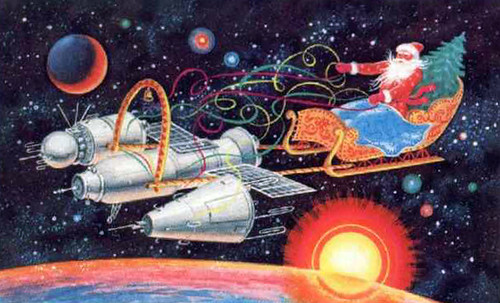
The idea is basic memetic warfare. By leveraging imagery inherent to the Republic's memetic landscape in such a way as to showcase the CM, “Santa” works to inspire the Jovians toward developing a desire, and then a demand, for nanofabrication. Though Christophie believes that this taste for post-scarcity will naturally lead to breakdowns of the fascist regime and an upswelling of nanarcho-democracy, co purchased two griefers after that first run, smuggled them into Liberty City, and began an art/propaganda campaign to ensure that result.
The team has grown, now including 4 transhumans other than Christophie and Rudolf:
* a Titanian journo and hacker covering this daring and artistic effort to undermine the Junta (and hoping to get on MRGCNN in the process) who goes by the name “Goodness's Sake” when embedded as one of Santa's elfs,
* Eetu Laakso, a surya child born after the Fall who won an @-list contest to get a place as an elf last year,
* an AGI from the Jovian moonlet Carpo who loves Christmas as only a virtual Victorian who's lived its life almost entirely in simulspace can and goes by the name Florence Beechworth, and
* Batch Quanta, a scum bot jammer who's one of the Lost, who both serve “Santa” as reindeer
-----------------------------------
* In 1 AF, the Council of Liberty was held on Ganymede. There, the Jovian Catholic Church was founded and almost immediately experienced their first schism. Shortly after the appointment of the Exilic Pope, a large number of delegates stormed out, railing about the Line of Peter, apostolic succession, and the mass murder of the College of Cardinals by the TITANs. These priests quickly began to build what they called the Anarchic Roman Catholic Church-in-Exile, founded upon the theological claim that God had ushered in a new period of the Church in which it had to find His grace without the protection and guiding hand of Peter. Ironically, the ARCCiE both enabled the hardline bioconservatist elements within the JCC to embed their beliefs in doctrine and theology and also represents the closest theology (if not liturgy) to that of pre-Fall Catholicism, as the JCC has incorporated a few elements of American Protestantism (including Mormonism), Russian Orthodoxy, and Chinese Patriotic Catholicism into what does still remain a Roman Catholic framework.
The third largest post-Fall Catholic denomination is a small but rapidly growing group within the ARCCiE. They call themselves the Anarchist Catholic Church of the Enduring and New Third Scripture (ACCENTS). Building a new theology out of combining anarchist political theory with Catholicism, they have begun to compile a new Scripture or Testament from the texts of Christian anarchist and communist writers. Thus, it includes the Books of Francis, the Book of Petr Chelčický, the Books of the Diggers, the Hopedale Book, the Books of William Greene, the Book of the Kingdom of God, the Book of David Lipscomb, the Book of the Heavenly Discourse, the Book of Thomas Hagerty, the Books of Nikolai Berdyaev, the Revelation of Precarity, the Book of Ammon, the Books of Dorothy Day, the Book of Peter Maurin, the Books of Ernst Bloch, the Book of Jacques Ellul, the Books of the Berrigan Brothers, the Book of Ivan Illich, the Book of Diane Drufenbrock, the Book of Camilo Restrepo, the Book of Vernard Eller, and the Books of Alexandre Christoyannopoulos.
Subscribe to:
Posts (Atom)